
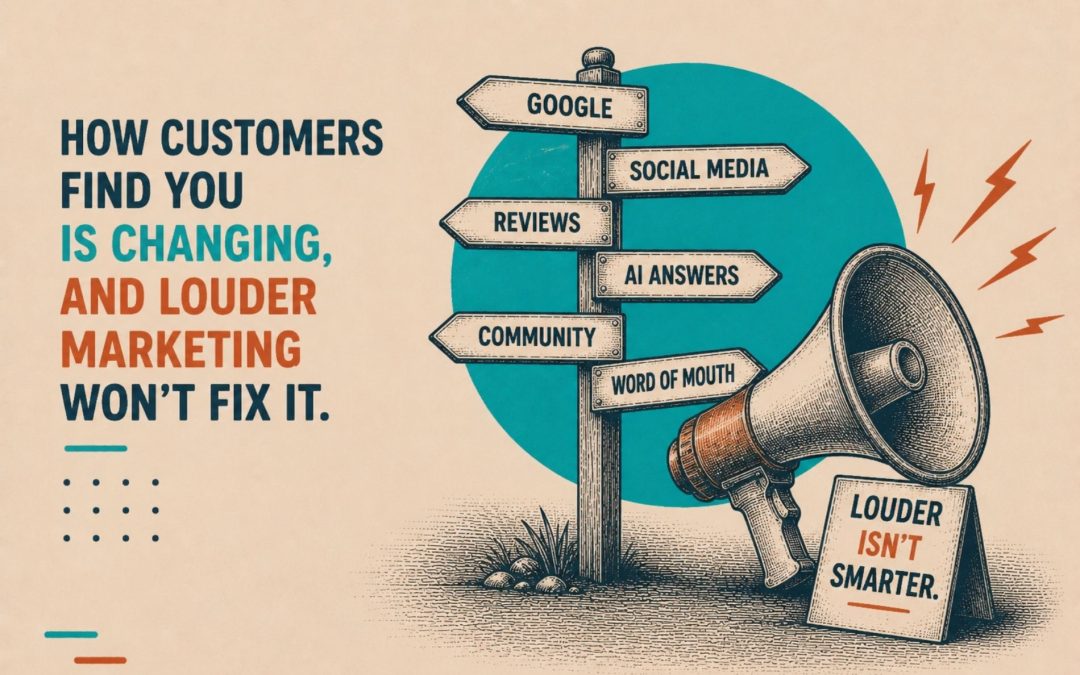
The discovery shift
Ask most marketing agencies how to get more customers and the answer is usually some version of more. More ads, more posts, more reels, a bigger presence across more channels. It is familiar advice because it used to be roughly right. When someone looking for what you sell opened Google and scanned a list of ten links, being visible on that list was most of the job. That world is quietly ending, and the businesses still optimising for it are aiming at a target that has moved.
How customers find you now is a two-step process: they ask someone they trust, or type a question into a search box, and then they verify. Increasingly that search returns a single summarised answer rather than a list, and the business named in that answer is the one that gets the call.
This matters because the decision is often made before anyone contacts you. By the time a prospective customer reaches your website, they have usually already chosen you or ruled you out. If the summarised answer to who does what you do, near you, does not include your name, you are not in a slow lane. You are not in the race at all.
The instinct to be more visible is not wrong, and it is worth saying so plainly. Visibility still matters. A business that is invisible online, with a thin or missing Google listing and a website that loads slowly and says nothing specific, will lose to one that shows up clearly. The agencies pushing presence are right that absence is fatal, and right that the channels have multiplied faster than any owner actually running a business can personally keep up with.
Where the advice holds up best is at the very start. A brand-new business with no footprint does need to build one, and the early gains from simply being present and accurate are real. If you have never claimed your Google listing, or your site has not been touched since 2019, then more is genuinely the right first move.
Where it breaks down is the assumption that getting found is still a volume game. The unit of discovery has changed. It is no longer a ranked list of ten links competing for a click. It is, more and more, a single answer assembled by a machine: a Google AI overview, an assistant summarising the options, a model deciding which one or two businesses are worth naming.
You are no longer trying to appear on a list. You are trying to be the answer.
How do customers actually find you now?
Trace a real path. Someone’s dishwasher floods the kitchen on a Sunday. They ask a neighbour, who mentions a plumber they rate. They do not call straight away. They search the name, glance at the rating, then ask a broader question to be sure, something like an emergency plumber in their suburb. A few years ago that returned ten links. Today it increasingly returns a composed answer that names a couple of options and explains why. The customer chooses from that shortlist. Word of mouth started it, but search and AI finished it.
The shift is not cosmetic, and what earns a place in that answer is not spend. Search systems and AI models assemble their summaries from sources they can read clearly and have reason to trust: a business listing that is complete and consistent, a website that plainly states who you help and what you do, real content that answers the questions customers actually ask, and the same details repeated reliably across the web. They are looking for legible, corroborated trust. They are not counting your ad impressions.
This is why louder marketing does not move the new target. A paid ad can buy a click, but it does not make you the business an assistant recommends when no ad is shown. A burst of reels can lift a follower count without ever being read by the system composing the answer your customer sees. You can be busy across every channel and still be absent from the one place where the decision now gets made.
The change in plain terms: customers no longer choose from a list of ten links. They choose from a short answer that names one or two businesses. Your job is to be one of those names.
Why being the obvious answer beats being everywhere
The good news for a small local business is that you are not competing with the whole internet. You are competing to be the clear answer to one narrow, valuable question: who is the business for this area and this problem. That is a winnable contest. It rewards depth over breadth, the business with genuinely useful answers published under its name and a consistent, credible footprint, not the one with the widest scatter of thin activity.
It also rewards patience, because trust of this kind compounds. A single strong month does not change how a system rates you. A year of accurate, useful, consistently published material does. Each helpful page, each corroborating mention, each accurate listing adds to a picture that is hard to fake and harder for a competitor to overtake quickly. The work is slow to start and then difficult to dislodge, which is the shape of an asset worth owning. It is the thinking behind how we work, and the reason we start every business with a clear, honest look at where it actually stands rather than a bigger ad budget.
The obvious objection is that this is overstated, that customers still just ring the business their mate named. Often they do, and word of mouth remains the strongest source of new customers for most small businesses. But notice what happens between the recommendation and the call. The verification step, the quick search to confirm you are real, reputable and nearby, now runs through exactly the surfaces described here. Word of mouth gets you onto the shortlist. The search decides whether you survive it.
The second objection is fairer: this is a long game, and a business with a quiet week needs customers now. True. Paid ads can fill a short-term hole, and there are weeks when that is the right call. The point is not that paid never works. It is that paid rents attention while the work described here builds an asset you own. A business that relies only on rented attention is exposed the moment it stops paying. The aim is to need the rental less over time.
What to do differently this month
Start by seeing what a customer sees. Open a private browser window, ask both a search engine and an AI assistant the question a real customer would ask, the kind of business you run plus your suburb, and look honestly at whether you appear and what is said about you. That five-minute exercise tells you more than most agency reports.
Then fix the legible basics before anything clever. Make your Google Business Profile complete and accurate. Make your website state, in plain language, who you help and what you do. Publish straight answers to the questions customers actually ask, under your own name, consistently, over months rather than weeks. Keep your business name, address and phone number identical everywhere they appear. None of this is glamorous, and all of it compounds.
And stop grading your marketing by reach. Impressions, followers and ad clicks measure how loud you are. The thing that now decides whether a customer finds you is whether the systems making the recommendation can read you clearly and have reason to trust you. Become the obvious, credible answer for your area, and being found stops being something you chase every week and starts being something you own.
Common questions about how customers find you
Does AI search really matter for a small local business?
Yes, and increasingly so. Search engines and assistants now compress results into short answers that name only a few businesses. For a local business, being one of the names in that answer matters more than ranking somewhere on a long list of links.
Will Google Ads still bring in customers?
They can, particularly for filling short-term gaps. Ads buy attention while it is paid for. They do not, on their own, make your business the option a search or assistant recommends when no ad is shown, which is why they work best alongside a durable presence rather than instead of it.
I do not have time to publish content every week. Is this realistic?
It is, because consistency beats volume. A handful of genuinely useful pages that answer real customer questions, kept accurate, will do more than a daily scramble across five platforms. The aim is a small amount of the right work, repeated, not more work.
How long before my business becomes the recommended option?
There is no fixed timeline, and anyone promising one is guessing. The pattern is gradual: consistent, useful publishing and an accurate footprint build over months and then become hard to displace. It compounds rather than spikes.

General marketing commentary, not advice tailored to your specific business.