
First principles
There is no shortage of marketing advice for small business, and almost all of it is about tactics. Should you be on TikTok. Is email dead. Do you need a podcast, a newsletter, a new website. The fashionable answer changes every year, which is the first clue that it is the wrong place to start. Strip the noise away and marketing only has two jobs: get found by people who do not know you yet, and keep the people who already do. Most struggling marketing budgets are pouring money into the first while quietly ignoring the second.
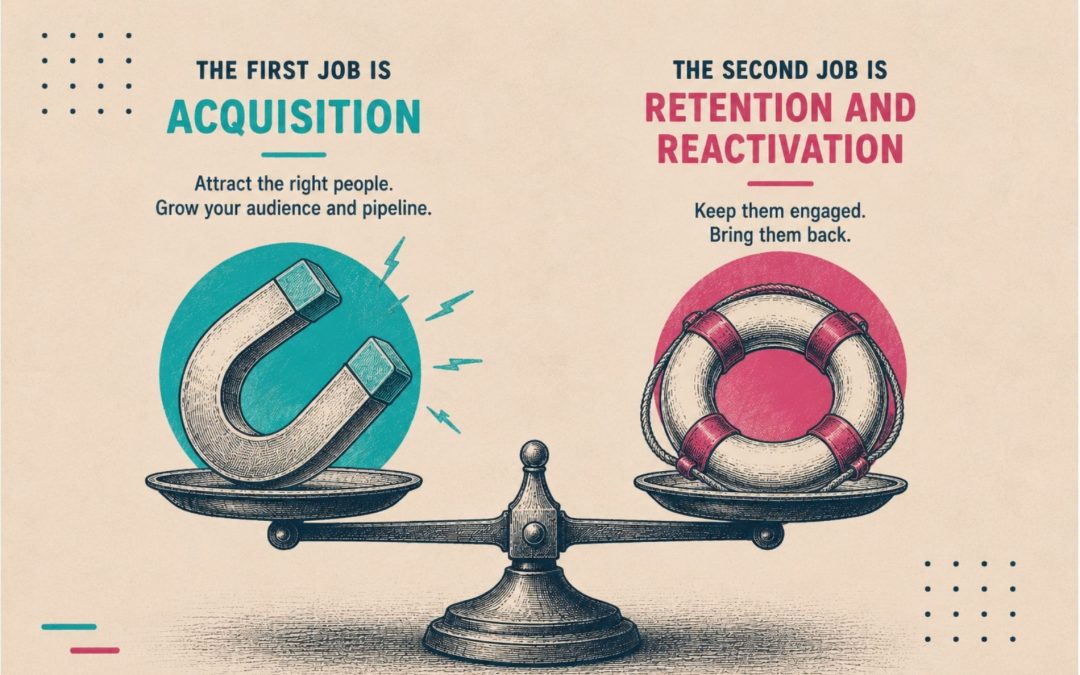
The first job is acquisition. It is everything aimed at someone who has never heard of you: showing up when they search, being mentioned by a friend, running an ad, ranking for the thing you do. The second job is retention and reactivation. It is everything aimed at someone who already knows you: the customer who bought once and drifted, the list of past enquiries sitting in your inbox, the people who would happily come back if you gave them a reason. One job fills the bucket. The other stops it leaking.
To be fair to the first job, it matters enormously, and it is worth saying so before arguing the other side. A business with no flow of new customers does not have a marketing problem, it has a countdown. You cannot keep customers you never won in the first place, and there are seasons, especially early on, when finding new people is the only thing that counts. Anyone who tells you acquisition does not matter is selling something.
The problem is not that businesses do the first job. It is that they do almost nothing else. The entire budget, the ad spend, the agency retainer, the owner’s nervous energy, all of it points outward at strangers, while the people who trusted you enough to pay once are left to quietly forget you exist. It is widely accepted in marketing that winning a brand-new customer costs several times more than keeping or reviving an existing one. Yet the existing ones are exactly who most businesses spend the least on.
New customers are how you grow. Existing customers are how you profit.
The first job: getting found
Getting found is the job everyone understands, because it is the one that feels like marketing. It is ads and search and being seen. It deserves real attention, and the way it works has shifted: being found now has less to do with being everywhere and more to do with being the obvious answer when someone goes looking. We wrote about that change in how customers find you is changing. The trap is not doing this work. The trap is believing it is the whole game, and grading your marketing only by how many new faces it drags through the door this week.
The two jobs, plainly: get found by people who do not know you, and keep and win back the people who do. A healthy business does both. Most do one, and then wonder why growth feels so expensive.
The second job: keeping and winning back
The second job is quieter and far cheaper, which is precisely why it gets skipped. Somewhere in your business is a list: past customers, old enquiries, people who bought once and were never heard from again. For most small businesses that list is the single most valuable and most neglected asset they own. These are people who have already decided you are worth paying. Reaching them again does not require an ad budget or a clever campaign. It requires a reason to come back and a simple, regular way of staying in front of them: a useful email, a timely reminder, an easy path to leave a review or refer a friend. It is unglamorous work, and it compounds. It is also the first thing we look at when we sit down with a business, before anyone mentions a single ad.
Why the second job gets ignored
If the second job is cheaper and more profitable, why does almost everyone skip it? Part of the answer is honest psychology: a new customer feels like growth, and a returning one feels like luck, even though the returning one is usually worth more. But part of the answer is less comfortable, and it is worth naming. Acquisition is where the marketing industry makes its money. New-customer work is visible, billable and easy to dress up in a dashboard: more ads, more reach, more leads. Retention makes the people selling marketing look less necessary, because a business whose existing customers keep coming back simply needs to buy less attention. An agency paid to manage your ad spend has little reason to help you depend on it less.
There are fair objections. The first is that you do not have much of a list, so this cannot apply to you. In our experience that is almost never true; even a modest list of past customers, contacted well, will out-earn the same money spent chasing strangers. The second is that emailing past customers feels like pestering them. It does, if the message is about you. It does not, if the message is useful to them and arrives when it is welcome. The line between valued and annoying is not frequency, it is usefulness. The third objection is that this is slow. It is. So is acquisition. The difference is that the second job builds something you own rather than something you rent.
What to do this month
You do not need a system to start, you need a list and a reason. Pull together everyone who has bought from you or seriously enquired. Send them one genuinely useful message, not a sales blast, something that helps them whether or not they buy again. Then make it effortless for happy customers to leave a review or send someone your way. That is it. Do that consistently and you will have started doing the half of marketing that most of your competitors never get to.
Common questions about the two jobs
Isn’t getting new customers more important than keeping old ones?
Both matter, and you need acquisition to survive. But they are not equally efficient. A returning customer usually costs far less to reach and is more likely to buy, which is why a business that only chases new ones tends to grow slowly and expensively.
I don’t have a big customer list. Does this still apply?
Almost certainly yes. The value is not in the size of the list, it is in the fact that those people already trust you. A small list of past customers, contacted well, usually outperforms the same effort spent on strangers.
Won’t emailing past customers annoy them?
Only if the message is about you rather than useful to them. People rarely resent a business that helps them and stays in touch sensibly. Usefulness, not frequency, is what separates a welcome message from an unwelcome one.
I’ve only ever done the first job. Where do I start?
With a list and one useful message. Gather your past customers and enquiries, send something genuinely helpful, and make it easy to leave a review or refer a friend. Start there before you spend another dollar finding new people.

General marketing commentary, not advice tailored to your specific business.