
Built to leave
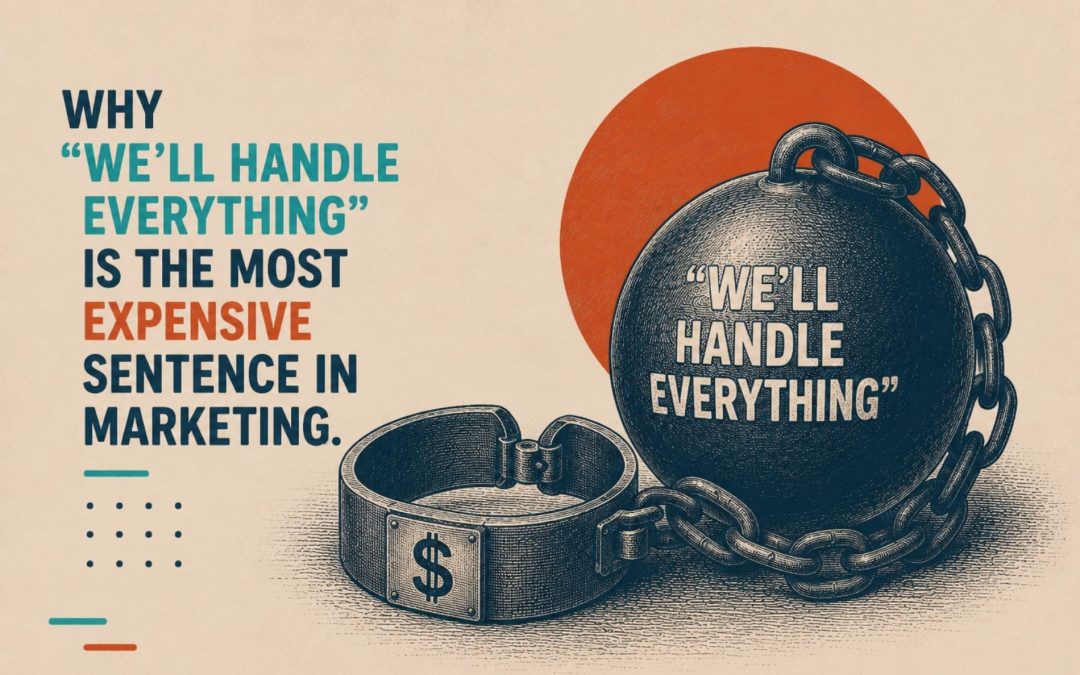
There is a sentence that turns up in almost every marketing pitch, and it is built to make you relax. We will handle everything. You just run your business and leave the marketing to us. It sounds like a weight lifted, which is exactly why it works. It is also, for a lot of small businesses, the most expensive thing they will ever agree to, not because of the monthly fee, but because of what quietly comes attached to it.
Let us be fair to it first, because the sentence is not all bad. Delegation is not the enemy. No owner should be doing everything themselves, and there is genuine value in handing specialised work to people who are faster and better at it than you are. If you are losing your evenings to ad settings you do not understand, paying someone to take that off your plate can be one of the smartest moves you make. The problem is not getting help. The problem is a specific kind of help, the kind designed so that you can never stop needing it.
The difference is hard to see at the start, because at the start they feel identical. Both take the work off your hands. Both come with a friendly account manager and a tidy report. The gap only shows up later, on the day you wonder what would happen if you left. With one kind of help, you would walk away with everything that was built. With the other, you would walk away with nothing, because nothing was ever really yours.
There is a difference between someone who helps you, and someone you cannot afford to leave.
What the sentence really buys
What you are buying with we will handle everything is peace of mind today. What you often pay for it is leverage tomorrow. The costs are quiet and they compound. There is dependency: the longer it runs, the more your marketing lives in someone else’s hands and the harder it is to take back. There is opacity: work happens that you cannot see and cannot judge, so you have no real way of knowing whether you are getting value or just getting invoices. There is ownership: your ad accounts, your analytics, your customer data, your Google listing, all of it sitting in their name rather than yours. And there is capability: every month you do not understand even the basics is a month you cannot make an informed decision about your own business. None of these feel expensive in any single month. They are ruinous over years.
The test: if you stopped paying tomorrow, would your marketing keep working, or would it switch off? If it switches off, you do not own it. You are renting it.
Help, or held?
Healthy help and quiet capture look the same from the outside, so judge them by what happens at the edges. With healthy help, the assets are in your name, you can see what is being done, and if you left tomorrow you would keep everything that was built. The provider makes themselves useful, not indispensable, and is happy for you to understand your own marketing. Capture is the mirror image. The accounts are theirs. The reporting is vague. Leaving means starting from zero, and somehow the conversation always steers away from how anything actually works. The tell is never the monthly service. It is what they do when you ask about leaving.
This is the whole reason we build the way we do. We would rather set your marketing up properly, show you how it runs, and hand you the keys than keep you on a drip. It is less lucrative for us, which is precisely the point. A provider who profits from your dependency has no reason to end it. One who is built to leave has every reason to make you self-sufficient.
What to ask before you hand it over
You do not need to become a marketer to protect yourself. You need five questions, and the willingness to notice whether they are answered plainly or dodged.
- Do I own the accounts and the data, in my name, with my access?
- If I leave, what exactly do I keep?
- What happens to my marketing if I stop paying you?
- Will you show me how it works, or only that it is working?
- Can I cancel without penalty?
A good provider answers all five without flinching, because none of the answers threaten them. If the answers come wrapped in caveats, or you are made to feel difficult for asking, you have your answer about which kind of help you are being offered.
Common questions about handing over your marketing
Isn’t delegating my marketing a good thing?
Often, yes. Delegation is healthy and most owners should not try to do everything. The issue is not handing work over, it is handing it over in a way that leaves you dependent, in the dark, and unable to leave with what was built.
How do I know if I’m too dependent on a provider?
Ask yourself the test: if you stopped paying tomorrow, would your marketing keep running or switch off? Then check who owns the accounts and data. If leaving means losing everything, you are renting your marketing rather than owning it.
What should I actually own?
Your domain and website, your customer list and data, your ad and analytics accounts, your Google Business Profile, and your social accounts. All of it in your name, with your own access. Anyone helping you should be working inside your accounts, not their own.
Doesn’t “built to leave” just mean I have to do it all myself?
No. It means the system is yours and could be run by you or by anyone you choose. You can still pay for ongoing help if you want it. The difference is that you are choosing to, not trapped into it.

General marketing commentary, not advice tailored to your specific business.
Recent Comments